Wednesday, December 23, 2015

Mt Kaputar, Split Rock Dam, Ellenborough and Apsley Falls

Mt Kaputar Trip Dec. 2015
Mount Kaputar National Park is a national park in Australia, surrounding the proximities of Mount Kaputar, a volcano active between 17 and 21 million years ago. It is located 50 km (31 mi) east of Narrabriand 570 km (354 mi) northwest of Sydney. Millions of years of erosion have since carved the volcanic region into the lava terraces, volcanic plugs, and dykes of Nandewar Range. The central feature of the region is Mount Kaputar, the park's namesake, which rises to an altitude of 1,510 m (4,954 ft).[2] The 360 degree view from the summit of the mountain encompasses about 1/10 of New South Wales' area or 80,000 km2 (31,000 sq mi).
The park protects a wide range of biomes, including semi-arid woodlandsubalpine heath, and eucalypt forests, and provides a habitat for a range of animals, including batsbirdswallabiesquolls, and the unique red triangle slug (Triboniophorus graeffei), which is known to appear after rainfall.

History

Before it was a national park, the area was used largely as grazing land for domestic animals. The conditions in the park are very harsh, but several pioneering families lived there, and remnants of their occupation remain. Sheep and cattle continued to graze on the plateau until around the 1950s. It was an isolated place, and the stockmen in charge of the cattle often would not see another human for months at a time.
In 1925 some 775 ha (3 sq mi) of land around Mount Kaputar were declared a "Reserve for Public Recreation". Two years later, a trust, known as the Mount Kaputar Trust, was formed to give guidance on managing the park. The area was expanded to 14,244 ha (55 sq mi) and proclaimed a full national park in 1959.
The park is popular with rockclimbers, and there are 11 walks in the park, as well as a camping ground. However, the most popular site in the park is Scutts Hut, located upward of Kurrawonga Falls. The hut is the former home of the Scutt family, a pioneer family living in the vicinity of the park.
Sawn Rocks
                
     
Stormy Weather


Hidden Wildlife!


Dawson's Springs Campsite
Mt Kaputar


This is a view of the road from Ellenborourgh to Ellenborough Falls.


Friday, October 9, 2015

How to spend all day getting from Tamworth to Gloucester.

Monday 28/9/2015

Julie and I traveled to Moonbi to catch up with a couple of friends we have not seen for a while. We had a look at the Crowell's place which we had not seen before. Some very impressive prize winning sculptures,
Tamworth to Barry
Map part 2

Barry to Barrington Tops


After a very cool night with the Roses it was on the back road to Gloucester via Chaffey Dam.


Sunday, July 19, 2015

July 2015, The Corner Country

A brief getaway.

I was fortunate to be invited to travel with a couple of blokes to have a look at the Corner Country of NSW.
The plan was to have a look at Gundabooka National Park and then Sturt National Park.


Day 1

Swimming in the hot mineral waters of the bore has been a popular recreational activity for many years with its therapeutic value long recognised. The water temperature is 37 degrees year round.

Day 2

Gundabooka 
A walk from Dry Tank campground took us to a ridge  where we could see Mt Gundabooka.

This is where the bushranger known as Captain Starlight was captured.

Bennetts George


Unfortunately the road into Mulgowan (Yappa) Aboriginal Art site was closed due to wet weather.


The Bennetts George access road was open.


Next stop was Shindy's Inn at Louth. The only other customer there turned out to be one of Matts friends uncles, it can be a small world.


Unfortunately we missed the Celtic Cross.
(More Information)

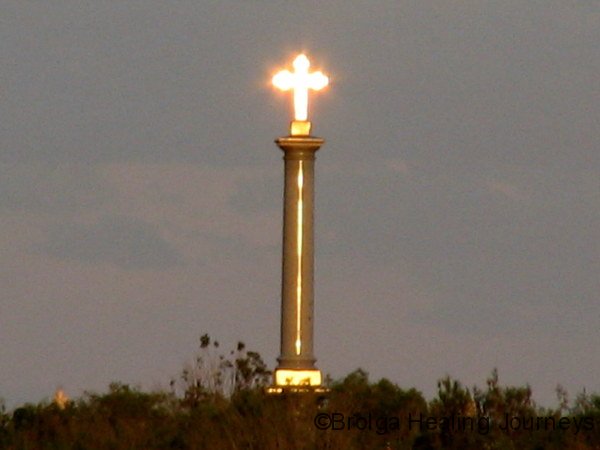
            The monument at sunset.


The Tilpa Pub is right on the banks of the Darling River.


From here it was on to Packsaddle for lunch, then to White Cliffs for a nice hot shower. Up on the hill overlooking town, it became obvious we were actually walking around on the top of residences called "dugouts" for obvious reasons.


In the distance you can see the parabolic dishes that provide power to the town.


I guess you could call this the back yard !
These places appeared to be connected to town water so I guess the tanks would be for "hot" water. Note the solar panels and TV aerials. Some had ventilation shafts and skylights.


Cobham Lake


The next stopover was the other hottest place in N.S.W, Tibooburra. (Aboriginal for "Heaps of Rocks"
Kev's daughter Billie named this land form "Bum Rock"


There was a message in the Tibooburra roadhouse window asking for help to deliver some supplies to Camerons Corner with which we were happy to oblige. We delivered the bread and had smoko with Fenn and Cheryl. From here it was off to Fort Grey. One of the things we had a look at there was the Sturts tree walk. This included the old bore pump which is still there.


In 1844, Captain Charles Sturt led the Central Australia Expedition from Adelaide, then along the Murray and Darling rivers before heading where no European had been before. The objective was to find the sea which Sturt and his supporters believed lay in the heart of Australia.

On his journey, Sturt left calling cards in the form of an S and an arrow, indicating that he had been there and the direction of travel. Sturt’s Tree walk in Sturt National Park offers a unique opportunity to view a piece of Australian history; one of the trees marked by Charles Sturt all those years ago.

The walk takes you across Lake Pinaroo, so you can only walk when the lake bed is dry which it was.

Our next site we visited was Olive Downs. We were able to travel via Middle Roads which were in good condition.
I said goodbye to Kev and Andrew as they were heading to Mt Wood and I wanted to have a look at the country further north. I left NSW via Warry/Warri gate and turned at the Tickalara turn off and headed for Thargominda on the Bulloo River road.
Looking forward "on roads seldom crossed 'cept by them that are lost"


Looking back
Note: the only tracks were mine! 
Despite appearances, this road was very smooth, and very straight. I was able to sit on 80kph.


Mmmmm    Bacon!

Better camera required.

Bulloo River

After an overnight stay in Thargominda, it was on towards Hungerford and Currawinya National Park along the Dowling Track.


The Hungerford "Royal Mail Hotel" was constructed in 1873 of corrugated iron, which was transported over 200 kms from New South Wales on bush tracks. It is the original building, which is still in use to this day. The Royal Mail was originally a Cobb & Co Staging Post where weary horses and travelers gained some respite from the road, heat and infrequent floods. Even Henry Lawson, the Poet, had an Ale at the Royal Mail, and a welcome break from the harshness of the Outback countryside. The Royal Mail, as it was in the past, is still a meeting place for the locals, families, shearers, stockmen, and a resting place for travelers who all enjoy the homely, unsophisticated, friendly feel of this iconic Outback Pub.

Royal Mail Hotel Hungerford.
From here it was keep heading East to Enngonia for lunch at the Oasis Hotel.(2 pubs in 2 states in 1 morning, a coffee in one and a tea in the other, I must be getting old!) Back to Bourke to fuel up and look for an overnight camp. As I was leaving town, a small road train pulled out ahead of me which turned out to quite handy. He was travelling at 90 kph which is the optimum speed for my little truck so I tucked in behind him, away from all the skippys. 

Over night camp and a swim at Burren Junction in the free camp at the bore. As I continued homewards, I was keeping an eye open for a different route home and spotted a sign to Manilla. Another sign pointed towards Dripping Rock. 

Dripping Rock car park is reached via an unsealed road which is 4WD only. Surrounded by a lush forest of Melaleucas, the waterfall is only a short stroll from the car park. As you emerge from the trees you will be greeted by a spectacular semi-circular cliff towering over a small rock pool. Water tumbles over the cliff from a height of 50m completing the heavenly scene. The sedimentary nature of this cliff allows water to seep through the rock, leaving it dripping with condensation, hence the name.


While passing through Manilla I spotted a sign pointing to Bendemeer. This is Halls Creek Rd. A beautiful run up a narrow winding road, steep in places, with beautiful scenery. This track also had a few creek crossings so precaution would be required if raining heavily or at night.

Thursday, January 15, 2015

Up the Creek from Kempsey


I was at work last week when a customer asked where would be a nice place to camp away from the crowds. A bit of a tall order during January School Holidays.

I recommended a couple of places, and looked at a map and saw a couple of others which I had no knowledge of, so I consulted a friend, Kev Smith, who is a wealth of local knowledge. When I found out the customer was an overseas visitor, I recommended a couple more sights and she invited me to join her.


We both had a little difficulty initially finding the camp site which is on a TSR.(Click here for a location map) but the views along the way were very spectacular.


The view up the valley.


More information can be found on Kev's web page


This is a two  way road used by trucks.
The return trip home was via Slim Dusty's childhood  home at Nulla Nulla Creek where at the age of 16 he wrote "When the Rain Tumbles Down in July"
 

Another resident from this area, Shorty Ranger, who lived just down the road and was a lifelong friend of Slim's, wrote a song which I was reminded of as we drove past Five Day Creek.
"from Five Day Creek to Kempsey it took weeks to bring a load"
This is from  "The Old Rusty Bell" and it went like this


 While admiring  this part of Australian History, we were lucky enough for the property manager to pass by and he stopped for a chat. The property is still in Slims family.


and just for Petra, "Cafe' Zonder Bier"  by Bobbejaan Schoepen

Oh it's-a lonesome away from your kindred and all
By the campfire at night we'll hear the wild dingoes call
But there's-a nothing so lonesome, morbid or drear
Than to stand in the bar of a pub with no beer

Now the publican's anxious for the quota to come
And there's a far away look on the face of the bum
The maid's gone all cranky and the cook's acting queer
Oh what a terrible place is a pub with no beer

Then the stockman rides up with his dry dusty throat
He breasts up to the bar and pulls a wad from his coat
But the smile on his face quickly turns to a sneer
As the barman says sadly the pub's got no beer

Then the swaggie comes in smothered in dust and flies
He throws down his roll and rubs the sweat from his eyes
But when he is told, he says what's this I hear
I've trudged fifty flamin' miles to a pub with no beer

Now there's a dog on the v'randa, for his master he waits
But the boss is inside drinking wine with his mates
He hurries for cover and he cringes in fear
It's no place for a dog 'round a pub with no beer

And old Billy the blacksmith, the first time in his life
Why he's gone home cold sober to his darling wife
He walks in the kitchen, she says you're early Bill dear
But then he breaks down and tells her the pub's got no beer

Oh, Billy the blacksmith, rides home on his horse
The cops bull him over, but he's sober of course
He blows in the bag and they all shed a tear
It's no place for a Booze bust 'round a pub with no beer

Oh it's hard to believe that there's customers still
But the money's still tinkling in the old ancient till
The wine buffs are happy and I know they're sincere
When they say they don't care if the pub's got no beer

These are not the original lyrics, there are many different versions and I will try and find John Williamson's version that I was lucky enough to hear him perform at the first Country Music Show held at the pub in the 1970's